Most people use the two names for the same job
Across the web and in person, the two names cover the same work. A crew comes to the house with a wand on a hose, and the wand runs water at a higher pressure than a garden hose. The method varies by surface and by crew. When you call around, the useful question is not which name a business uses but how they wash each surface.
Some crews draw a line between the two names on purpose, often to signal a hot-water setup. Others do not.
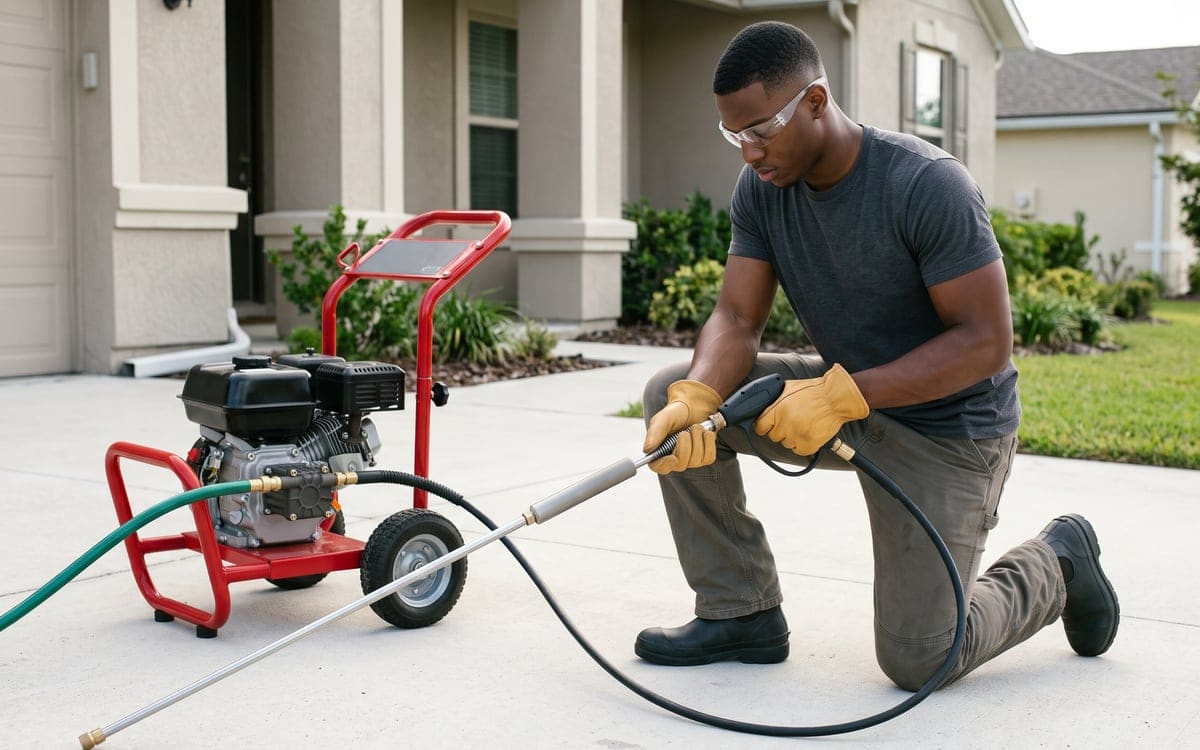
Some crews use "power washing" for heated water
Where a line is drawn, it is usually the hot-water line. A pressure washer runs at ambient water. A power washer, in that reading of the words, runs the water through a heater before it leaves the wand.
Hot water has its uses on commercial jobs with grease, where warm water loosens the film more easily than cold. On a residential wall or walkway, cold water is plenty.
What matters more is the pressure at the surface
What the water does at the wall or the slab depends on the nozzle size, the wand distance, the angle and how long a spot gets water, more than the number on the pump.
| What varies on a wash | Why it matters at the surface |
|---|---|
| The pressure at the pump | Sets the upper bound of what the wand can do |
| The size of the nozzle | Changes how much water lands per second |
| The distance of the wand | Spreads or concentrates the water |
| The angle of the wand | Decides whether the stream drives into the surface |
| How long the wand sits over a spot | Lifts stains or just drives water past them |
| Whether a soap is laid on first | Changes what the rinse does |
A trained crew runs the same gear at different settings for a stucco wall and a concrete slab. A soft wash at low pressure is the method on the wall; a driveway wash runs at a higher pressure on the slab.
Soft washing is the third name
A third name shows up in the trade. Soft washing is a low-pressure method that lays water onto a surface, dwells for a time, then rinses it off.
Soft washing is the method on stucco, painted siding, trim, screens and most roofs. For a side-by-side look at soft washing and pressure washing in plain terms, that post sits next to this one. All three can sit on one quote for the same house.
What to ask instead of which name they use
The method is the useful question when you call around. Ask how a crew handles stucco walls versus a concrete drive, and whether they wash a roof from the ground. Ask what they do about plants and furniture before the pass, and how they handle wash water.
The City's rules on hoses, driveways and gutters covers the water side those answers should land in. What moves the price covers how a crew builds a quote once the surface list is in hand. For a wider look at hiring, picking a pressure washing company in Los Angeles walks through the first call.
A short dictionary for the first call
If you have not called a crew before, two words come up on most quotes. A soft wash runs at low pressure with time at the wall, used for stucco, painted siding, trim and screens; a pressure wash runs at higher pressure on paving.
A full services page lays out the pieces of a house job in those terms.