Los Angeles is a city of apartments
Buildings of five or more units are a large share of the city's housing. About 48 percent of the city's housing units are in buildings of five or more units.1 The rental side matches: of the city's occupied homes, renters occupy about 64 percent.2
A manager with a dozen walkways and three courtyards has a different list from a single-family house, and the first call is a different call.
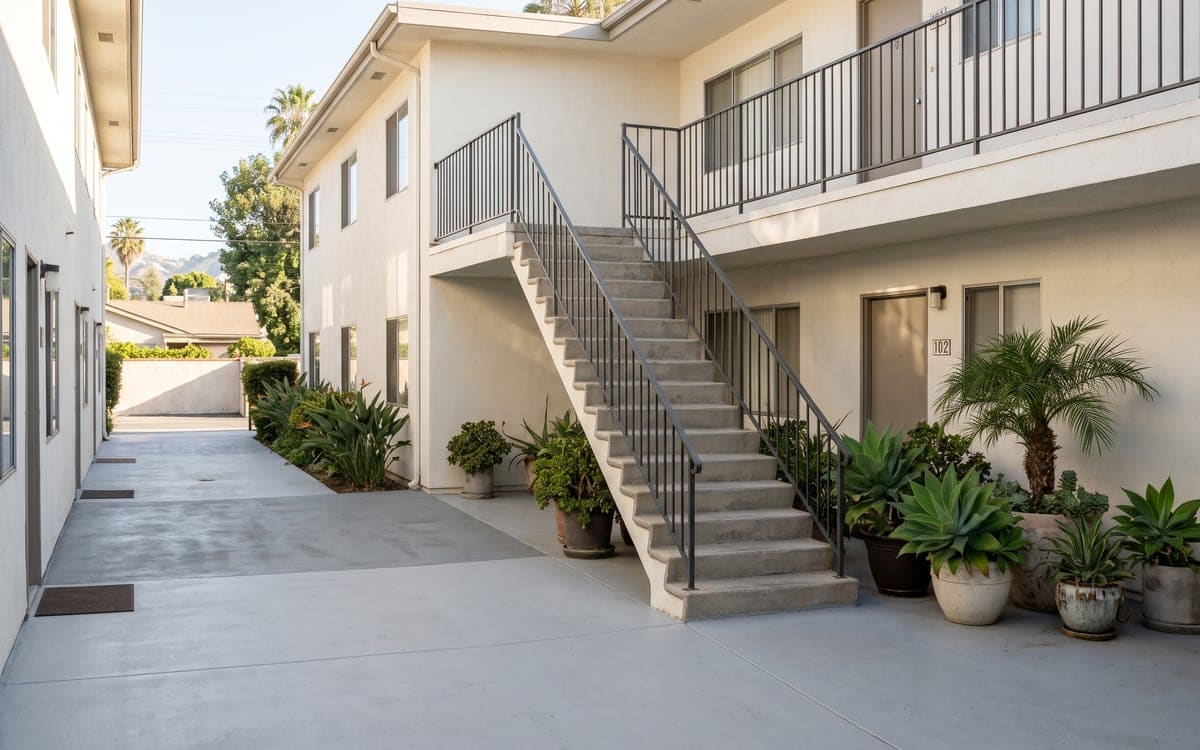
Walkways, stairs and courtyards take the most foot traffic
The surfaces that need the most attention are the ones everyone walks on: front walkways from the sidewalk to the entry, shared concrete between the parking area and the units, outdoor stairs on a two-story walkup and the courtyard between the wings of a U-shaped building.
Those surfaces wear in traffic lanes, which is a clean word for the darker stripe down the middle of a walk where feet have moved over it for years. The edges can still look clean while the center is already two shades darker.
A wash on an apartment building leads with those surfaces. The walls can come second, the parking last, and the dumpster area pulls its own plan. For the paving side of the surface list, a full driveway and walkway wash covers how a pass runs.
What to tell us when you call
Useful things to share: the unit count, whether the building is one story or two with stairs between, how parking is laid out and whether there is a courtyard with units' doors onto it. Mention where the outside spigots are, whether the building has pets and any special tenant needs.
For a plain price feel, what moves the number on a building wash covers the inputs. The surfaces, their height, the stair count and the courtyard size all shift the number more than the name on the invoice.
Stucco walls on dingbats and courtyard buildings
SurveyLA counts the dingbat, the stucco box apartment of 1954 to 1968, as part of postwar Los Angeles, once common throughout certain parts of the city.3
The pass on stucco uses a soft wash method that runs at low pressure. A courtyard wash is a different pass from a wall wash; the surface underfoot is the lead piece.
| Building type | What the wash leads with |
|---|---|
| Two-story stucco walkup | Walkways, outdoor stairs, car-port ceiling |
| Dingbat | The stucco face |
| Bungalow court | The shared walkway in the court |
| Small duplex or triplex | Walkways, entry walls, trash enclosure |
A full house wash runs through the walls, trim and the outside of the gutter on the building face.
Parking areas and the City's hose rule
The parking area is often the surface with the most ground-in marks, and it sits inside the water rules a wash in Los Angeles runs under. The City's rules on hoses, driveways and gutters cover the water side.
Who arranges the wash
Who pays for the wash and who schedules it is a conversation between the owner, the manager and the tenants. This page does not give legal advice.
The person who calls can be the owner, a property manager, or a tenant the owner has asked to coordinate.