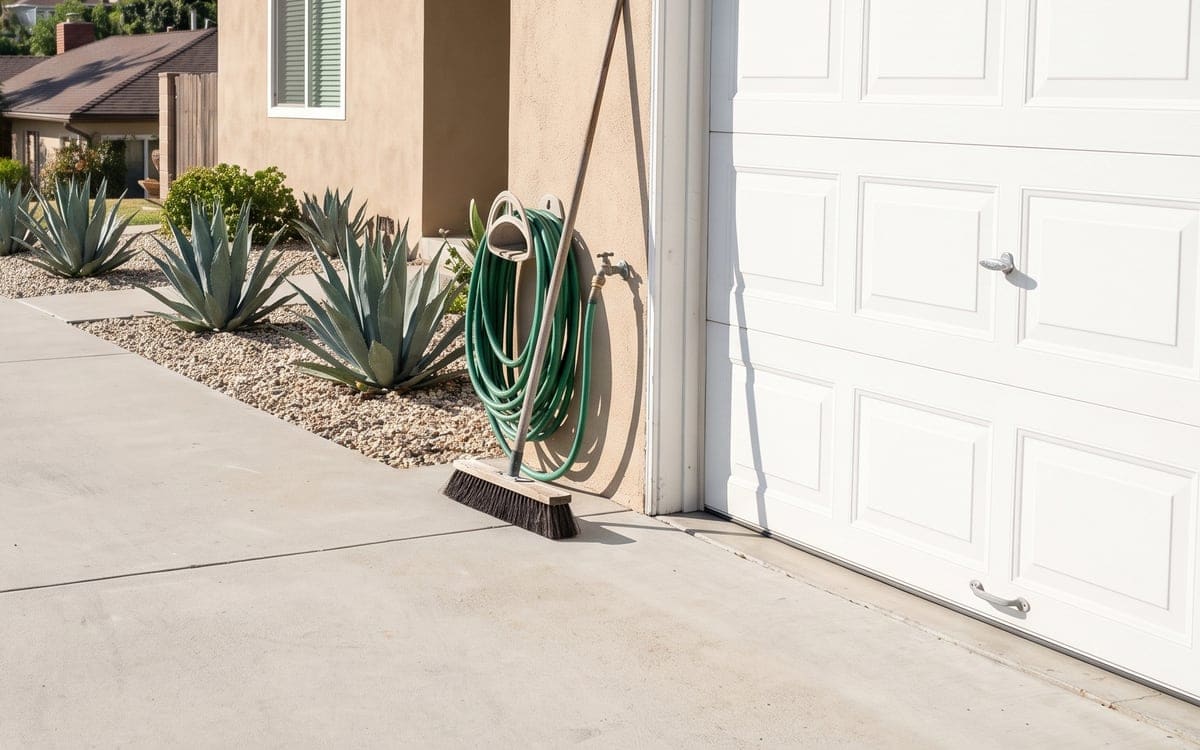
A garden hose on a driveway is against City code
No Customer of the Department shall use a water hose to wash any paved surfaces, including, but not limited to, sidewalks, walkways, driveways and parking areas, except to alleviate immediate safety or sanitation hazards,1 says LAMC 121.08. The exception is for immediate safety or sanitation, not for a dirty slab. LADWP's watering fact sheet puts it plainer: You may not wash down hard surfaces such as sidewalks, walkways, driveways or parking areas.2 The rule covers the ordinary garden hose on a weekend afternoon.
The ban is permanent, whatever the drought phase
The hose rule is not a drought measure that goes away when a wet winter comes through. The provisions of Section 121.08 A. shall take effect immediately upon the effective date of this Article, shall be permanent, and shall not be subject to termination.1 The ban stays in the code regardless of the current conservation phase.
The second half of the rule names the exception. This section shall not apply to Department-approved water-conserving spray cleaning devices. Use of water-pressure devices for graffiti removal is exempt. A simple spray nozzle does not qualify as a water-conserving spray cleaning device.1 The code points at Department-approved devices as the exempt category and does not list which machines qualify. In the code's own words, a simple spray nozzle on a garden hose does not qualify.
In City code, streets and gutters are part of the storm drain
Where runoff goes is not where most people picture it. The Storm Drain System in City code means any facilities or any part of those facilities, including streets, gutters, conduits, natural or artificial drains, channels and watercourses that are used for the purpose of collecting, storing, transporting or disposing of stormwater.3 Water that reaches the street in front of your house has already reached the storm drain in the code's terms.
What Los Angeles code says about washing
Paraphrased from the City code sections linked in this guide.
Barred
- Hosing driveways, walks and other paved surfaces
- Business runoff from washing hard surfaces reaching the storm drain
- Leaves and dirt put into the storm drain system
Also in the code
- Streets and gutters are part of the storm drain system
- Approved water-conserving spray cleaning devices are exempt from the hose rule
- A contractor's water use counts as the customer's
Sources: Los Angeles Municipal Code, Chapter XII, Sec. 121.06 to 121.08 (codelibrary.amlegal.com); Los Angeles Municipal Code, Chapter VI, Article 4.4, Sec. 64.70.01 to 64.70.03 (codelibrary.amlegal.com).
That definition changes how most people picture runoff. Water that sheets off a drive and finds the gutter is not on its way to a drain; it is already in the drain. Sweeping leaves to the curb and rinsing them with a hose puts the leaves in the storm drain system.
Runoff from washing hard surfaces stays out of the drain
Businesses that wash hard surfaces carry a specific responsibility. For industrial or commercial activities, no person shall discharge, cause or permit the discharge of untreated runoff from the washing of impervious surfaces into the storm drain system,3 says LAMC 64.70.02, which calls those discharges an infraction. In its car washing practices for nonprofit car washes, the Board of Public Works says do not empty buckets of soapy or rinse water into the parking lot, street, gutter or storm drains; always empty buckets into the sanitary sewer.4
Where the drain goes
Stormwater and urban runoff pick up non-point pollutants such as sediment, airborne chemicals, pet waste, trash, oil, and other auto fluids and carry them into the storm drains which flow to the local rivers, creeks, and the ocean untreated,5 per LA County Public Works. The City of Los Angeles tracks runoff pollution in four local watersheds, the Los Angeles River, Ballona Creek, Dominguez Channel and Santa Monica Bay, and cleans about 100,000 catch basins a year on average.6
Leaves and dirt do not go to the curb either
Sweeping is the other path to the storm drain. City code bars the intentional disposal of leaves, dirt or other landscape debris into the storm drain system.3 Pushing a pile of leaves off the drive and across the sidewalk to the gutter counts, because the gutter is part of the system.
Water a hired crew uses counts as yours
A plain line in the code is worth knowing before anyone works on your drive. A use of water by a tenant or by an employee, agent, contractor or other acting on behalf of a Customer whether with real or ostensible authority shall be imputed to the Customer.1 Water a hired crew uses on your house counts as your own use on the LADWP account. It is a calm reason to ask any company how it plans to handle the water on your drive.
The sidewalk exemption is not about a home driveway
The sidewalk exemption that sometimes gets quoted is for City of Los Angeles and Business Improvement District crews on public sidewalks, not for home driveways. The Board of Public Works is specific about who the exemption is for. Discharges from the washing and cleaning of public sidewalks into the storm drain system are conditionally exempted ... This sub-section applies to the manual cleaning and washing of public sidewalks performed by the City of Los Angeles or through contracts with Business Improvement Districts.4 It is the City's own crews and district contractors, on public sidewalks, under conditions set by the Board.
Even those crews have to sweep first and use high-pressure, low-volume spray with potable water and no cleaning agents.4 The home driveway, the apartment courtyard and the front walk are not covered.
Neighbors can report runoff
The County makes it easy to flag runoff that reaches a drain. LA County Public Works maintains a countywide hotline and website that includes information on public reporting of clogged catch basin inlets and illicit discharges and dumping.7 A neighbor who sees the gutter running with soapy water from the house down the block has a way to call it in.
What to ask any company about its water
A price and a plan for the water are both worth asking about on the first call. Ask any company, ours included, how the plan works on your drive before any water runs. The code is the same for everyone who washes in Los Angeles, and the right answer is specific to your drive, your side yard and the slope to the street.
Three questions to ask any crew about water
Ask them before the work starts. A good answer is specific to your driveway and your street.
Where does the wash water go?
Not the street, the gutter or a drain.
Whose spigot and whose water?
Water a crew uses counts as yours.
What gets swept up first?
Leaves and dirt get bagged, never sent to the curb.
Sources: Los Angeles Municipal Code, Chapter VI, Article 4.4, Sec. 64.70.01 to 64.70.03 (codelibrary.amlegal.com); Los Angeles Municipal Code, Chapter XII, Sec. 121.06 to 121.08 (codelibrary.amlegal.com).
A short set of questions covers it: where the wash water goes on this drive, whose outside spigot the crew works from, and what gets swept up and bagged before the wash. The right answers name the drive, the slope and the gutter in front of your house.
The services linked below sit under the same rules on every job: a full house wash runs through the walls, a driveway wash handles the slab and the slope, and the services page covers the rest. What goes into a price and the method on each surface both touch water handling. The FAQ page answers common questions in short form.