Stucco cleaning starts with low pressure
A hard blast at a stucco wall mostly drives spray back at the person holding the wand without cleaning more, because the pockets catch the water the same way they catch the dust. A soft wash does the work. The water goes on, dwells long enough to loosen what is in those pockets, and gets rinsed off from top to bottom. The same method covers painted stucco, trim and screens.
For houses with mixed walls, a soft wash on the walls pairs with higher pressure on the drive and the paths, since concrete takes more than stucco does.
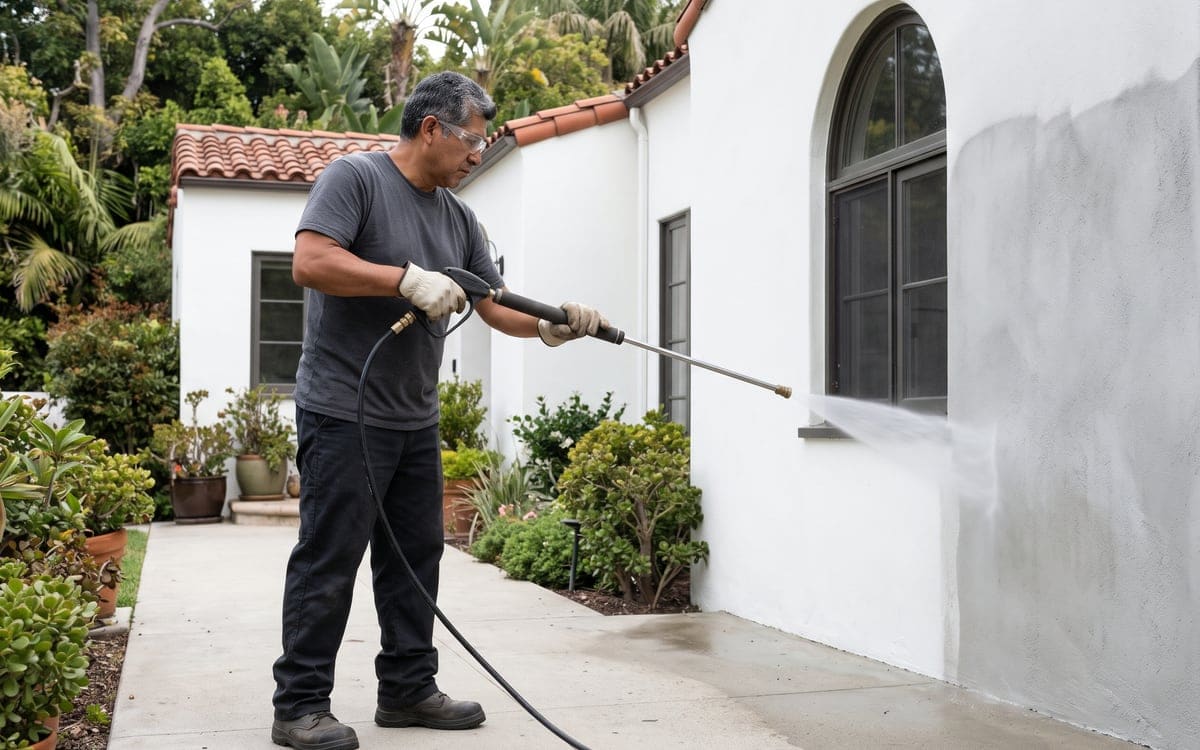
Smooth stucco and sand finish wash differently
Not all stucco is the same. A smooth, trowel-finished wall almost reads as painted plaster, with few pockets and a glass-smooth top coat. A heavy sand finish, a lace finish or a knockdown wall is deeply textured, with pockets you can run a fingernail into. The rougher the finish, the more surface it has to hold what settled on the wall across the year.
On a smooth, trowel-finished wall, the dust and film come off at the wall. On a sand finish or heavy lace, the pockets hold more, and the water has to lay into them before any rinse.
| Stucco finish | What the surface is like | How the wash runs |
|---|---|---|
| Smooth, trowel finish | Nearly flat; low pocket depth | A soft-wash pass |
| Sand finish | Shallow pockets across the whole wall | A soft wash with time at the pockets |
| Lace or skip-trowel | Deeper hollows and ridges | Soft wash, careful on the ridges |
| Knockdown | Flattened lace with mixed pockets | Soft wash, careful on raised peaks |
| Painted smooth stucco | Pockets filled by paint | A light-handed soft wash |
The finish is not always obvious from the street. Describing it on the call is enough.
What builds up on a stucco wall in Los Angeles
Stucco walls carry a familiar mix of marks: a dust line down the lower courses where sprinkler spray lands, shaded sides a shade darker than their sunlit neighbors with a dull gray-green film in the lowest few feet, cobwebs and dust under the eaves, splash lines under a planter and vertical streaks under a window with no overhang above it.
Describing what you see is enough to plan the pass. We check which beds and plants sit against the walls and where the outside spigot is. The City's rules on hoses, driveways and gutters sit with the water side of the job.
Cracks and loose patches go to a plasterer first
A stucco wall that is already damaged is not a wash job. Hairline cracks let water into the wall assembly behind the finish, and a wash puts water right at those cracks. Loose patches that lift under a fingernail or sound hollow when you tap them have lost the bond to the layer below, and a rinse can take them off the wall entirely.
Patching goes to a plasterer first, and the finish gets a chance to cure before a wash runs. Chimney stucco, foundation stucco and the long thin cracks that run down from the corner of a window are the usual places to look first. If any of those are on the wall, bring it up when you call.
Painted stucco and older paint get a light hand
Older paint on stucco can chalk, flake or lift at the edges of patches over time. A wash does not take peeling paint off a wall as a service. If paint is already lifting on the wall, that work is a painter's.
Even where the paint is sound, we keep the pressure low so the method stays a rinse. Where a wall is heading into a repaint, we can wash the sections that are staying as they are and leave the painted ones for the painter.
Stucco across Los Angeles, from Spanish houses to dingbat apartments
SurveyLA dates the city's Spanish Colonial Revival period to 1915 through 1942 and calls the style prevalent in single- and multi-family neighborhoods.1 Later postwar apartments brought another type: SurveyLA counts the dingbat, the stucco box apartment of 1954 to 1968, as part of postwar Los Angeles, once common throughout certain parts of the city.1
About 44 percent of the city's housing units were built before 1960.2 We work from what the wall is doing up close rather than the year on paper.
To group the walls, trim and eaves on one quote, a full house wash covers how a pass runs. For the difference between a soft wash on the walls and higher pressure on paving, soft wash and pressure wash in plain terms sits next to this one. The surface list that moves the price covers what changes the number once the walls are measured.